Discover Otopeni · · 2 min read
What to check before signing the preliminary contract: the notary’s and the land registry expert’s list
A preliminary contract is not “just a piece of paper”. The checklist I go through before any signature, built together with a notary and a land registry specialist.
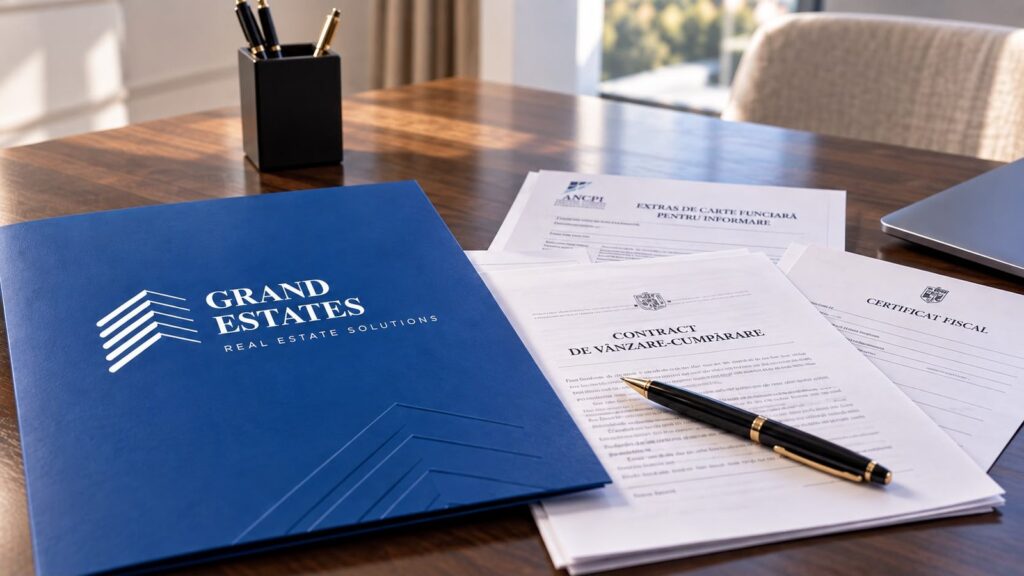
Most transactions that get stuck do not get stuck on price. They get stuck on paperwork, three days before the notary appointment, when everyone is tired and nobody can back out without losing something. The list below is what I go through — with the seller before a buyer appears, and with the buyer before they pay the deposit.
The title documents
- The title deed — a sale contract, an inheritance certificate, a deed of gift, a court decision. Not just “it is my house”, but the paper that says so.
- The succession — if the owner named in the deeds has died, the succession has to be settled beforehand, not “at the notary, together with the sale”. It is the most frequent cause of delay I see.
- The land registry extract — a recent one. It shows the owner, the charges (mortgages, prohibitions) and any notes.
- The tax certificate — you cannot sell with debts to the local council.
The cadastral documentation: the house on the ground has to be the house in the papers
- The area in the deeds versus the area on the ground — on older plots the differences are common.
- The buildings — an extension, an enclosed terrace, a garage: if they do not appear in the cadastral documentation, legally they do not exist. It can be resolved, but it takes time.
- The boundaries — the fence is not automatically the boundary of the property. The neighbour may have a different view, with documents to back it.
- The land registry entry — without it the buyer cannot get a mortgage, and the bank does not negotiate.
It is far better to find out now that you have something to sort out than when the buyer is waiting to sign. — Gabriela Șerbănescu, land registry specialist
The preliminary contract: the clauses that matter
- The price and the deposit — and what happens to the deposit if one of the parties changes their mind.
- The deadline for the final contract — realistic against the buyer’s mortgage and the seller’s paperwork.
- The conditions — obtaining the mortgage, resolving the cadastral documentation, vacating the property. Discussed for the actual case, not copied from another file.
- The condition of the property at handover — what stays, what goes, and in what state.
The clauses have to be discussed for the actual case, not copied mechanically from another transaction. — Vlad Sicoie, notary public, Notariat Solemnis
When to do the checks
Seller: in the week you decide to sell, not in the week you have found a buyer. Buyer: before the deposit, not after. Both conversations in full — with the notary and with the land registry specialist — are in the Conversations with professionals section and, together with the other two, in the PDF guide I send you free of charge.
Would you like me to check your paperwork before you put the property up for sale? We start with a valuation, with no obligation.